What to Make Cards On
Keep it clinical
Malleus is a clinical medicine deck. Cards must be primarily of clinical relevance — content is targeted at clinical years, final-year exams, and internship. Detailed preclinical content (e.g. the enzymes of the Krebs cycle) will be rejected, even if it's high yield for preclinical students. Unsure? Get in touch.
Stay in scope
We loosely base the deck's depth on the PassMedicine 'High-Yield' database — the level appropriate for a final-year medical student or intern. This stops the deck filling up with niche, specialty-college-level content. We've copied the PassMedicine topic list into this Google document so you don't need a subscription to check it.
Check it doesn't already exist
Before writing, search for existing cards three ways:
- Keyword search in the Anki Browser
- Topic search in the Malleus Anki Helper add-on
- The Malleus HQ 'Card Creations' project board for a topic's completion status (requires a free @malleus.org.au email — register on our website)
Test understanding, not memorisation
Write cards that test concepts, not isolated facts. Use clinical scenarios where possible, and follow two principles:
- Minimum information — each card tests the smallest essential unit of knowledge. One fact per card.
- Minimum cue — the question gives just enough information to trigger the answer, and no more. This is what makes recall transfer to the wards and exams.
Card Structure
Use question-and-answer format
Cards should be written as a question with a cloze-deleted answer, with few exceptions. Cards not in this format may be rejected.
Why only Q&A cards?
Poorly written cards can be "recalled" from their layout or wording rather than true understanding — easy to answer during review, unretrievable on the wards or in an exam. Q&A format with minimal cues largely avoids this.
Example:
Generally also include the inverse card:
Making multiple variations of similar cards is encouraged — it forces careful reading and prevents pattern-matching.
When inline cloze is acceptable
Fill-in-the-blank (inline cloze) is for the rare cases where Q&A doesn't fit — typically simple equivalences:
If you use inline cloze, make sure there's enough context to work out the missing words. Preview the card to check each cloze makes sense on its own.
Cards with multiple answers
- If a question has multiple answers, state the number in the question (e.g. "Name the 3 first-line options…"). Exceptions: when the count would make the card trivially easy, or when recalling the count is itself the point.
- Use the same cloze number for multiple answers to the same question — don't spread one question's answers over c1, c2, c3.
- For increase/decrease answers, give the hint in fixed order: {{c1::increases::increases/decreases}} — unless the answer is obvious.
One-by-one cards and mnemonics
One-by-one cards (clozes revealed in sequence) are only appropriate when the items have a meaningful order — a mnemonic or a sequence of treatment:
- The 5 P's of phaeochromocytoma can not be one-by-one — every item starts with P, so ordered recall is impossible
- Don't use one-by-one for cards with only 2–3 clozes, unless they're mnemonics
- To make a card one-by-one, type any text into the 'One-by-one' field
Before using a mnemonic as the card itself, consider a normal Q&A card with the mnemonic as a memory hook in the Extra field.
Randomised elements
The Malleus add-on can randomise card elements (numbers, image sequences, score calculations) so you can't pattern-match — useful for rash identification images and scoring tools (GCS, T-score cut-offs). Look for the Add Random button in the editor.
Style Guide
Spelling
Use Australian English. For medical terms with variant spelling (fetus/foetus, osteopenia/osteopaenia), follow the Australian Health Thesaurus, then the Concise Medical Dictionary for gaps.
Set up Australian medical spellcheck in Anki
- Add the addon:143753963 (ankiweb.net/shared/info/143753963)
- Open the addon settings and add the dictionary English (UK) (the English (Australia) dictionary is currently a combination of UK and US, and doesn’t work perfectly )
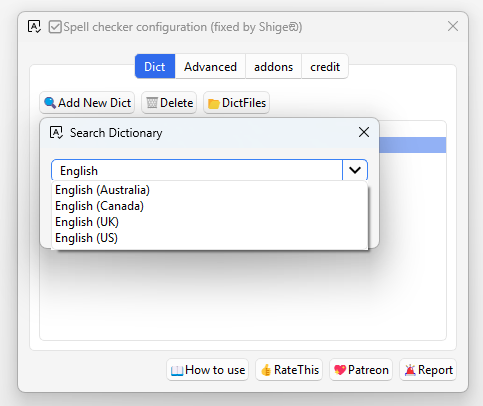
- For Australian medical spelling, download the following file,
📎 Australian Health Thesaurus Export for Anki Spell Check.txt
- Add this file to the ‘Personal dictionaries folder’:
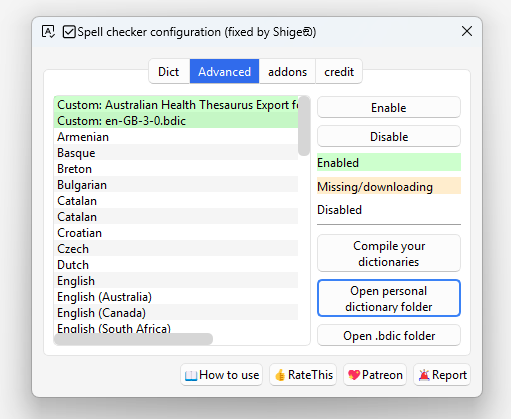
- Press the ‘Compile your dictionaries’ button
- You should now have a functional Australian medical spell-check function in Anki
Thanks to Health Direct for allowing us to use the AHT (licensed CC BY-NC-SA 4.0). Report any conversion errors to us.
Abbreviations and acronyms
Use abbreviations sparingly: write the full name, with the acronym in brackets — bold the disease name, leave the (abbreviation) unbolded. Check the Accepted Abbreviations table for what can be used without expansion.
Always fine to abbreviate:
- SI units
- Terms rarely written in full: anti-CCP, IgG/IgA, beta-hCG
- Chemical elements (ions with their charge in superscript)
- Medicine terminology per the ACSQHC recommendations
Writing about drugs
Do not put doses, brand names or timings in cloze answers. Route of administration may be included when clinically relevant (abbreviated per the national abbreviations guide).
- ✅ 'valaciclovir PO' ❌ 'valaciclovir PO 1 g mane'
Exception — doses are helpful for drugs interns chart constantly: common analgesics (paracetamol 500 mg), antiemetics (ondansetron 4–8 mg PRN), VTE prophylaxis, common antihyperglycaemics and antihypertensives, and emergency drugs (aspirin 300 mg in ACS, adrenaline 0.5 mg IM in anaphylaxis). If unsure, submit and the maintainers will make a call.
Capitalisation: drug names are lowercase unless starting a sentence; brand names (Panadol, Xanax) are always capitalised. Each listed regimen counts as a new sentence.
Combining drugs: join options with AND, PLUS, OR, EITHER, or BOTH — capitals, underlined, italicised. Put each regimen on its own line; never break a line mid-regimen:
| ✅ Acceptable | ❌ Not acceptable | |
|---|---|---|
| Alternative regimens | [Drug X] OR [Drug Y] OR [Drug Z] | [Drug X] OR [Drug Y] OR [Drug Z] |
| One regimen, multiple drugs | [Drug X] AND [drug y] AND [drug z] | [Drug X] AND [drug y] AND [drug z] |
(One regimen per line is also fine all on a single line if it fits.)
For complex regimens, one line per component — a three-drug regimen gets three lines; a numbered list can clarify the number of agents.
Bold, underline and italics
- Bold the topic/disease and key words — including 'augmenting' words that distinguish near-identical cards (e.g. vertical vs horizontal)
- Underline sparingly: the specific thing the question asks for, and augmenting words that are already bolded
- Italics only for genus and species (Staphylococcus aureus) — never for emphasis

Organisms and viruses: italicise organism names with the genus capitalised (Mycobacterium tuberculosis; abbreviate as M. tuberculosis); 'spp.' is not italicised (Vibrio spp.). Viruses are lowercase and not italicised except as acronyms — herpes simplex virus (HSV).
Eponymous diseases: possessive 's only if named for a patient (Lou Gehrig's disease), not for the describing physician (Alzheimer disease).
Punctuation and other conventions
- 'e.g.' and 'i.e.' (with dots, no following comma)
- Space between numbers and units: 10 mmHg, > 60%
- En dash for ranges: 9–10 mg
- Single quotation marks by default
- Capitals only for names and sentence starts
- No full stop after single sentences or bullet points; full stops only in multi-sentence paragraphs
The Extra field
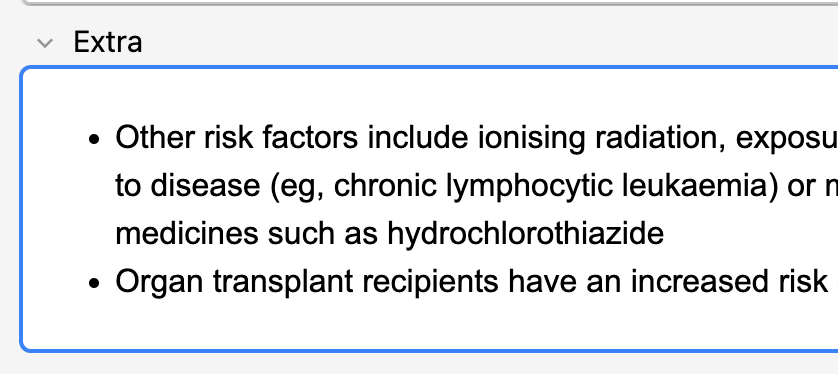
- Capitalise the first letter of each sentence
- Two or more sentences/points → format as a bullet list
Tables
Make tables with the Extended Editor for Field add-on (code 805891399): place your cursor in the field, open the extended editor, and use its table button. Avoid AI-generated tables — the formatting differs subtly from the add-on's.
- Resize images inside tables to a uniform height or width
- Tag every card containing a table:
#Malleus_CM::#Card_Feature::Table
Referencing
How to cite
Put at least one accepted source in the Source field, with a URL and a last-updated/accessed statement:
For books without a URL, give the DOI; if none exists: Chapter 13 - Talley, O'Connor (2017) Clinical Examination: A Systematic Guide to Physical Diagnosis, Elsevier. (no access date needed for published works). Consider AMA/Vancouver style (guide).
Multiple sources: list as bullets, mark one as primary, and prefix the others with 'Also see:'.
Creating hyperlinks in Anki — use this add-on, or open the HTML editor (< >) and write <a href="URL">Title</a> - RESOURCE - Last Updated … Accessed [date]
Accepted sources
See Recommended Resources for the full list. In brief:
- AMBOSS — link the specific article
- PassMedicine questions
- StatPearls
- Therapeutic Guidelines (see eTG tagging)
- Specialised: DermNet (dermatology), LITFL (critical care), Radiopaedia (radiology)
- Selected textbooks: Oxford Handbooks; Talley & O'Connor's Clinical Examination 8e; Llewellyn-Jones Fundamentals of Obstetrics and Gynaecology; Ellis & Calne's Lecture Notes in General Surgery 14e; First Aid 2024 (not for management)
- Society guidelines (RANZCOG, RACGP…) with website links
Unacceptable sources
First Aid 2023 or older · Pathoma · Boards & Beyond · Sketchy · Osmosis · Wikipedia · random articles · school lectures · unapproved textbooks · UpToDate (only with verification against local guidelines)
Images and copyright
Only use images that are public domain or carry an accepted Creative Commons licence. When unsure, ask us.
Every image needs a credit — italicised, font size 10pt, in this format:
Three ways to format the credit
- Recommended: Wrapper meta add-on (code 396502676) — highlight the credit, click the "quote" button
- Extended editor add-on — manually set 10pt italics
- Manually with the HTML editor — type the credit, set it to font size 10 and italics, and hyperlink the author and licence
Therapeutic Guidelines and RCH images: both have given us permission to reproduce content. TG screenshots go in the eTG Complete field (nothing else goes there; other images go in Additional Resources), must be limited to the minimum content needed to answer the question safely, and need a citation somewhere on the card.
Technical note: AnkiHub converts images to WebP (max 16,383 px per side) — split larger images into equal-width screenshots.
Free-to-use image sources — CDC PHIL · Gray's Anatomy · OpenStax · Radiopaedia · Retina Gallery · Wikimedia Commons · Smart Servier · StatPearls · DermNet
Tagging
#Malleus_CM::#TO_BE_TAGGED and we'll sort it out.How to tag
Malleus Anki Helper add-on — install the add-on and it applies the right tags as you create cards. If a page is missing from its search (especially eTG), contact us and we'll add it.
- Install the Malleus Anki Helper Add-on linked here: Malleus Anki Helper Addon - AnkiWeb, as shown in the video below.
- Watch the video series below for details on how to use the plugin.
Special tags
Some cards need extra tags beyond Subject + Rotation:
- Pharmacology — any card involving drugs
- eTG Complete — cards sourced from Therapeutic Guidelines
- Clinical Investigations — ABGs, ECGs etc.
- Guidelines — national and state-based guidelines
- High Yield Diagnosis — spot diagnoses from pathognomonic findings
- Risk Stratification & Scoring Tools
- Mnemonics
- OSCEs & Clinical Reasoning
- Question Banks — notably eMedici
- Textbooks — T&OC 8e, On Call (ANZ), Mechanisms of Clinical Signs 2e, Llewellyn-Jones 11e
- Anatomy & Physiology — mostly archived; prefer subject *General tags
Yield tags
Yield lets students work through the deck progressively: start with High-Yield for a safe, examinable foundation, add Medium for depth, then Low for mastery.
| Yield | What it covers | Examples |
|---|---|---|
| High | Essential to pass medical school and be a safe intern. Core exam content, foundational concepts, anything patient-safety-critical | First-line antibiotics for common conditions; red-flag presentations |
| Medium | Strengthens practice or exams but not strictly essential | Investigation pathways for less common conditions |
| Low | Rarely tested detail a top student might know; memorisation cost outweighs clinical payoff | Rare organism gram stains; split-second GCS/APGAR scoring drills |
| Beyond medical school | Beyond what students/interns are expected to know; for completeness and special interest | Specialist algorithms, subspecialty guidelines, receptor-level pharmacology |
Critical note update tags
Use only when an edit changes the fact or correct answer of a card — content errors, updated guidelines — so users with long review intervals see critical changes early:
#Malleus_CM::!CRITICAL_NOTE_UPDATES!::Content_Error/Updated_Guidelines::YYYY::MonthDon't use it for formatting, rewording, tag restructuring, or spelling fixes. Rule of thumb: if someone who learned the old card would now be wrong, apply the tag.
Synced Fields (Advanced)
Synced fields (introduced December 2025) share content across multiple cards — edit it once and it updates everywhere. They're collapsed by default and hidden from normal searches.
- Synced Extra and Synced Additional Resources content lives in the Synced Extra and Synced Additional Resources Notion databases
- Add content to the page body (takes precedence) or the content field; most formatting works, and an HTML code block passes through verbatim. A template is available — starting with a heading helps separate it from other content
- Fill the Subject relation (which disease/topic pages it belongs to) and the Subtag dropdown (which subtags it appears under; use 'Main Tag' for general pages)
- The Malleus add-on then offers the synced content automatically when users create or re-tag cards. Use Synced Extra sparingly — every use adds a prompt for users
Help Us Review
Most maintainers joined the team by consistently commenting, voting, and suggesting. Want to join? Email hugh.fenton-white@malleus.org.au (Lead Maintainer).